Great service from start to finish. The team was professional, reliable, and very easy to work with. Communication was always clear, and they kept me informed throughout the entire process.
Frosted glass film, without replacing the glass
A decorative film that recreates the etched, sandblasted glass look on your existing glazing. Privacy, style, and daylight, installed cleanly across Greater Montréal.
See all window film solutions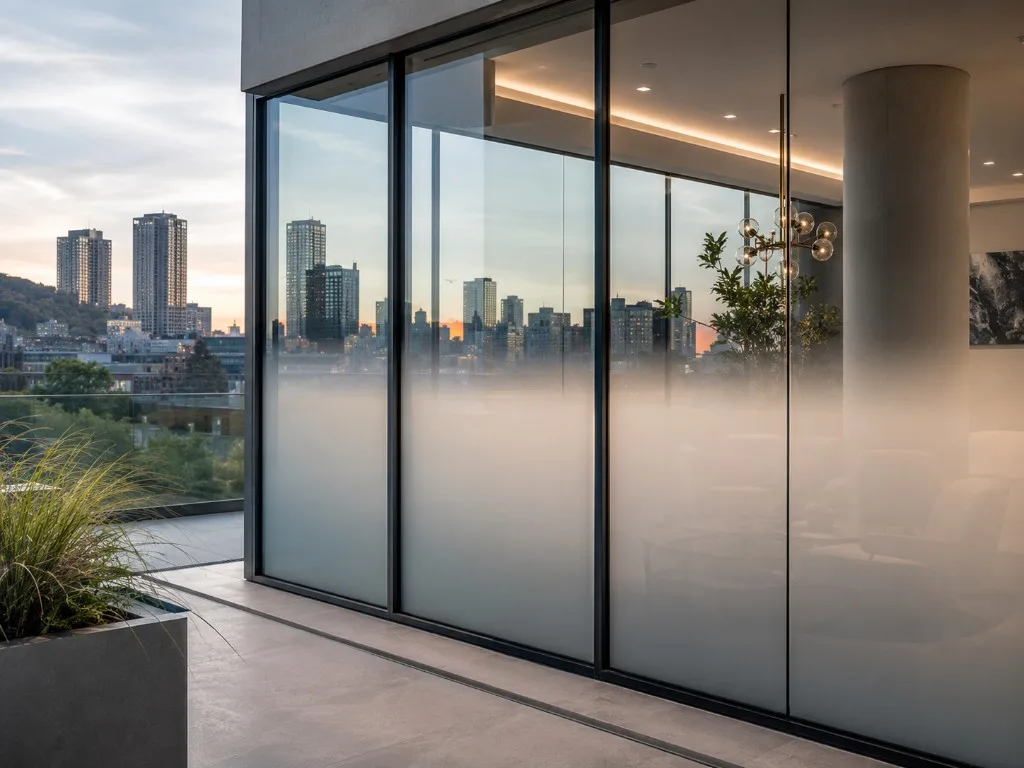
Overview
Frosted film gives you the look of sandblasted or acid etched glass without the cost, lead time, or disruption of replacing the glazing. It applies to the glass you already have. On an office partition it creates separation while keeping the space bright. On a glass door or a bathroom window it gives constant privacy that does not reverse after dark, which is the practical difference between decorative film and reflective privacy film. The finish ranges from fully opaque frost to a light textured crystal, depending on how much you want the glass to disappear.
Best for
- Office partitions and conference rooms that need separation without walls
- Glass doors, transoms, and sidelights
- Bathrooms and windows with direct sightlines from a neighbour or corridor
- Storefronts and commercial spaces that want branding or style on the glass
- Interior glazing where the space should stay bright but not open to view
What it solves
- Sightlines through interior glass without blocking daylight
- Privacy on a partition or glass door where blinds are not an option
- Plain glass that reads as unfinished or offers no visual separation
- The cost and lead time of ordering real custom frosted glass
- Meeting rooms that are visible from the open floor
What to know
- Frosted film recreates the sandblasted look but applies to existing glass. No replacement, no demolition, no downtime beyond the install itself.
- The effect stays constant day and night. This is the key difference from reflective privacy film, which reverses after dark when it is brighter inside than outside.
- UV rejection varies by product. White Frost rejects 99% of UV. More translucent etched finishes like Dusted Crystal reject considerably less. Confirm per product if fading is a concern.
- Partial height application is common: frosted on the lower portion of the glass for privacy at seated or standing eye level, clear above for daylight.
- Custom cut patterns, banding, and logos are possible on the same film.
- For privacy on a sun exposed exterior window, see privacy window film, which pairs privacy with solar control.
Specifying the film
Product types to consider
Start here before the SKU level. These are the categories we use to narrow the right XPEL film.
Opaque frosted
The classic frosted glass look. Maximum privacy while keeping light transmission. The default choice for partitions, doors, and bathrooms.
Translucent etched, crystal
A lighter textured finish for style and soft separation without full opacity. Used where the goal is character rather than privacy.
Full opaque, white or black
Complete blockout for storage areas, back of house glazing, and any glass that needs total visual separation rather than a translucent effect.
XPEL examples we specify
Published performance data from XPEL VISION. Exact results depend on glass, orientation, and the full glazing assembly.
White Frost (XVWFT)
65% VLT, 99% UV rejection, 33% total solar energy rejected, 28% glare reduction.
The classic frosted look with full UV protection. The standard specification for partitions, glass doors, and bathroom glazing.
In plain terms: the standard frosted look. Full visual privacy, most of the light kept, and it still blocks 99% of UV.
Dusted Crystal (XVDC)
86% VLT, textured crystal look, high clarity.
A light decorative finish when you want character without opacity. Lower UV rejection, so specify by exposure.
In plain terms: a textured, crystalline finish with more light than a standard frost. Note the UV rejection is much lower on this one. If fade protection matters, specify differently or pair it.
Black Out (XVBOT) and White Out (XVWOT)
Full opacity in black or white.
For glazing that needs complete blockout rather than a frosted effect.
In plain terms: a complete block, not a diffusion. Nothing passes through in either direction. Specified for storage, service areas, and anywhere the glass should stop being a window.
Compare the four families
Frosted film against the other three
Frosted film is one of four families we install, and it is the only one that gives privacy that does not reverse after dark. This is where each family lands on the properties buyers weigh, using one representative product from each. If you are choosing between frosted and reflective privacy film, the privacy column is the whole decision.
| Film family | Representative product | Visible light | Solar heat | Glare | Privacy effect |
|---|---|---|---|---|---|
| Privacy | Evening View 5 | 8% | 81%rejected | 92%reduction | Strong, daytime only. Reverses after dark. |
| Solar control | Clear View Plus 70 | 72% | 55%rejected | 20%reduction | None. The glass stays near clear. |
| Security | Security Clear 8mil | 89% | Not a solar product | Not rated | None. Fully transparent. |
| Frosted and decorative | White Frost | 65% | 33%rejected | 28%reduction | Constant, day and night. No view out. |
Nominal values from XPEL VISION published data on 1/8 inch (3mm) glass. Shown to compare families, not as a performance guarantee. Every family carries lighter and darker options than the single product listed here, and frosted finishes range from light crystal textures to full blockout.
Specification and install
Specifying and installing frosted film
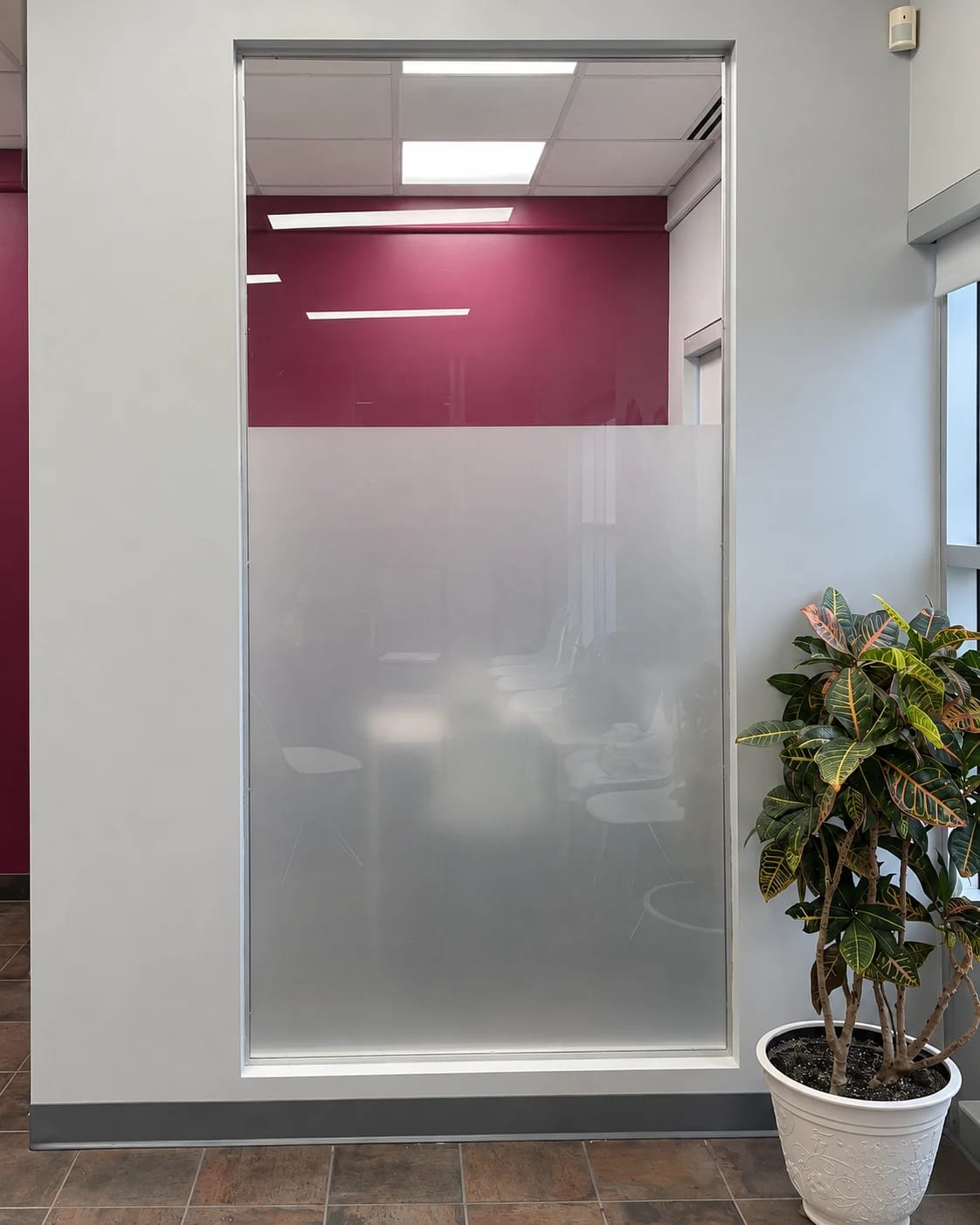
Frosted lower glass with a clear upper section.
View this installation in WorkChoosing the finish level
Frosted film is not one product. The range runs from a light textured crystal that reads as decoration to a full opaque blockout, and the finish level is the first thing to settle, because it decides whether the specification is about privacy or about appearance.
A standard white frost is the workhorse. It gives the classic sandblasted look, obscures detail completely while passing around two thirds of visible light, and rejects 99% of UV. This is the default for partitions, glass doors, bathrooms, and any glazing where privacy is the actual requirement.
A translucent etched or crystal finish passes much more light and obscures far less. It is a style choice, useful for adding character to a glass wall or marking a pane so people do not walk into it, and it should not be sold as a privacy product. UV rejection on these lighter finishes is considerably lower, so specify by exposure if fading matters.
Full opaque white or black blocks the view entirely and passes no usable light. It is the right answer for storage rooms, back of house glazing, server rooms, and anywhere the glass exists but the view should not.
Deciding the layout on the glass
Full coverage is only one option and often not the best one. On a floor to ceiling partition, frosting the whole pane makes a bright open space feel closed in and wastes the daylight the glass was installed for.
Banding is the common commercial solution: a frosted band across the glass at seated and standing eye level, clear above and below. It blocks the sightlines that actually bother people in a meeting room while keeping the space visually open and the borrowed daylight intact. Band height is set from the eye level you are addressing, and a room with a seated conference table needs a different band from a corridor.
Partial height, frosted on the lower portion with clear above, is the residential and street level equivalent. On a ground floor window it stops the sidewalk sightline while leaving the sky and the upper view untouched.
Manifestation, meaning the marking required so people do not walk into full height glass, is worth resolving in the same specification rather than adding a strip of dots afterwards. A designed band satisfies it and looks intentional.
Custom cut patterns, gradients, and logos are cut from the same film, so branding a reception partition is a layout decision rather than a different product.
What the installation actually involves
Film is applied to one face of the glass, and on an interior partition that face is a choice. The side facing the wetter or more heavily cleaned space, or the side that takes the traffic, affects how the film wears. On exterior windows it goes on the interior face.
The glass is scraped and cleaned first. Frosted film is less forgiving than clear film of anything left on the surface, because a translucent white layer shows contamination as a visible mark rather than hiding it. Preparation is most of the labour.
Application is wet. A slip solution lets the film be positioned and squared before it is squeegeed down, and squaring matters more here than anywhere else in the range: a band that is two millimetres out of level across a long partition is visible from across the room. Expect water on the glass, the frame, and the floor below.
Cut work, banding, logos, and pattern films are laid out and cut on site or pre cut to measured dimensions, which is why accurate measurement matters more on decorative jobs than on flat coverage.
The cure period, and cleaning afterwards
For the first few weeks the film can look slightly hazy or show small water pockets while residual moisture clears through the film. On frosted film this reads differently than on clear film, because the surface is already matte, so light unevenness during cure is normal and resolves.
Do not clean the film during that period and do not press the pockets out. Once cured, clean with a soft cloth and a mild soap solution or a non ammonia glass cleaner. Ammonia and abrasive pads will damage the matte surface, and on frosted film that damage shows as a polished patch that cannot be repaired without replacing the panel.
In washrooms and kitchens, wipe splashes rather than letting them dry on the surface. The matte texture holds marks more readily than clear glass does.
What to settle before you buy
Confirm you want constant privacy rather than daytime privacy. Frosted film does not reverse at night, which is exactly why it is specified for bathrooms, partitions, and doors. The tradeoff is that it removes the view out permanently, so it is the wrong product for a window someone wants to look through.
Settle the layout at eye level, in the room, before ordering. Band heights that look right on a drawing frequently do not once you are sitting at the table. Marking the intended band on the glass with tape during the site visit takes ten minutes and prevents the most common regret on decorative work.
For interior partitions, approval is usually a landlord or facilities question rather than a condo board one, because nothing changes on the facade. Exterior facing glazing is the opposite, and frosted film on a window visible from the street can fall under the same appearance rules as reflective film. Check which case you are in.
If the glass is sun exposed and fading is a concern, specify by UV rejection rather than by look. The standard white frost rejects 99% of UV, and the lighter crystal finishes reject considerably less.
What shapes the quote
How a frosted film quote is built
There is no catalogue rate for decorative film, and a number given before anyone has seen the glass is a guess. Frosted work in particular is driven by cut complexity rather than by area, so two jobs covering the same square footage can price very differently. What follows is what moves the total, so you can read a quote and understand why it says what it says.
What drives the variation
Cut complexity and layout
This is the biggest driver on decorative work. Flat coverage across plain rectangular panes is the fast case. Banding, gradients, cut patterns, and logos all add layout, measurement, and cutting time, and a custom pattern is a fabrication job before it is an installation job.
Glass area and pane count
Total area sets the baseline, but pane count matters as much. A partition run made of many narrow lites takes considerably longer than the same area in a few wide panels, because every pane is measured, cut, squared, and squeegeed on its own.
The finish specified
Material cost varies across the decorative range. Standard frost sits at one end, textured and patterned films and full blockout products sit higher, and printed or custom fabricated graphics higher again. The finish follows the requirement and the requirement moves the price.
Access and working height
Partition glass reachable from the floor is the straightforward case. Transoms, clerestory glazing, tall entrance glass, and anything above a fixed reception desk or millwork needs ladders or lifts, which adds both time and equipment.
Condition of the existing glass
Old film that has to come off first is the largest prep variable, and it is common on office refits where a previous tenant frosted the same partitions. Aged adhesive is slow to remove and the glass has to be brought back to properly clean, because frosted film shows what is under it.
Occupancy and scheduling
An empty suite during a fit out is the cheapest case and the easiest to schedule. Working around a live office, phasing meeting room by meeting room, or coming in evenings and weekends to avoid disrupting a floor all cost more, because the schedule is setting the labour.
We do not quote by the square foot over the phone. You get a fixed price for a defined scope after the glass has been measured, itemised by area or room, so you can see what the custom cut work costs against plain coverage and adjust the design if the budget needs it.
Questions
Common questions about frosted film
The questions we are actually asked on site visits, answered directly.
- Does frosted film give privacy at night?
- Yes, and this is the main difference from reflective privacy film. Frosted film obscures the glass by diffusing light rather than by relying on being brighter outside, so the effect is identical at midnight and at noon. Lighting inside changes nothing.
- Can you see through frosted window film?
- Not in any useful way with a standard white frost. Light passes through and you may register movement or a vague silhouette directly against the glass, but detail is gone. Lighter crystal and etched finishes obscure considerably less and should not be treated as privacy products.
- How is frosted film quoted?
- Per project, not from a rate card. Cut complexity drives it more than area does, so banding, patterns, and logos price differently from flat coverage. We measure on site and issue a fixed price itemised by area before anything is scheduled.
- How long does frosted film last?
- Interior decorative film on partitions and doors is among the least stressed applications in the range and generally holds up well beyond a decade, with a manufacturer warranty on the products we install. Cleaning method affects the matte surface more than exposure does.
- Can frosted film be removed, and does it damage the glass?
- It is removable and the glass underneath is unaltered, which is the practical advantage over real sandblasted or acid etched glass. Removal is a labour job rather than a peel, and older film with baked adhesive takes longer. It is quoted separately when part of a job.
- Do I need building approval for frosted film?
- For interior partitions and doors, usually a landlord or facilities sign off rather than a condo board, since nothing on the facade changes. Exterior facing glass is different and can fall under the same appearance rules as reflective film. Confirm which case applies before ordering.
- How long does the install take in an occupied office?
- A meeting room or a run of doors is usually a few hours. The room needs to be clear at the glass line and stays wet during application, so it is out of use that day. Full floors are phased room by room or scheduled after hours.
- Can it be cut with a logo or a pattern?
- Yes. Logos, banding, gradients, and custom patterns are cut from the same film, so branding a reception partition or marking full height glass is a layout decision rather than a different product. Cut work is measured and priced separately from flat coverage.
Reviews
What clients say on Google
5.0out of 5
23 Google reviews
Rated 5.0 out of 5 from 23 Google reviews.
Excellent service from Privé Window Films! The team was professional, knowledgeable, and paid great attention to detail throughout the installation. The finished result looks fantastic, and the added privacy and heat reduction have made a noticeable difference. Thanks again guys!
Reviews come from our Google Business Profile and appear as Google returns them, most relevant first. We do not select, edit, or reorder them.
Read all reviews on GoogleBest spaces
- Offices and commercial
- Partitions and conference rooms
- Glass doors and entrances
- Residential bathrooms, doors, and transoms
Get a film recommendation for your glass
Tell us the space, the orientation, and what you need the glass to do. We specify the film and quote the install.
Values from XPEL VISION published data, tested on 1/8 inch (3mm) glass. Nominal and for guidance. Exact results depend on the product specified and the glazing assembly.